
VeggieVerve Knowledge Base
What is your body asking for today?
Vitamin B12 for Plant-Based Diets: Energy, Nerves & Blood Health
Table of Contents
-
- Why Vitamin B12 Matters
- B12 and Energy: The Real Connection
- B12 and Blood Health
- B12 and Nerve Health
- Why Plant-Based Diets Need Special Attention
- How Much B12 Do Adults Need?
- Food Sources for Plant-Based Eaters
- Can Seaweed, Mushrooms, or Fermented Foods Provide Enough B12?
- Who May Be at Higher Risk of Low B12?
- Signs That May Suggest Low B12
- Testing: Why Guessing Is Not Enough
- B12, Folate, and the “Masking” Issue
- Smart Daily Habits for Plant-Based B12 Support
- The Bottom Line
- References & Footnotes
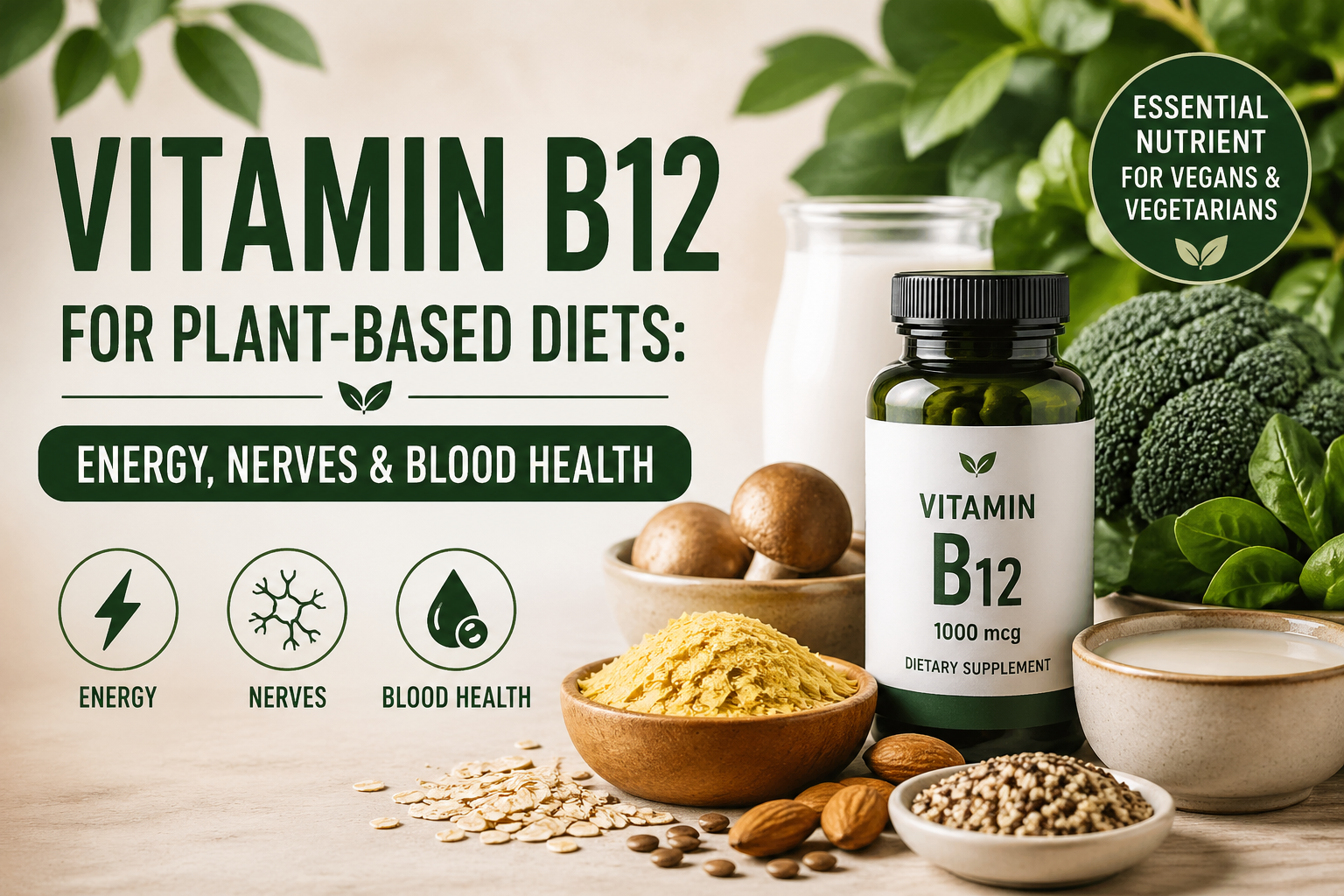
Vitamin B12 is one of the most important nutrients for anyone following a plant-based, vegetarian, or mostly plant-based lifestyle. It plays a key role in keeping the body’s nerve and blood cells healthy, supporting DNA production, and helping the body maintain normal energy metabolism.1
Unlike many vitamins found widely in fruits, vegetables, herbs, grains, nuts, and seeds, vitamin B12 is naturally found mainly in foods of animal origin. That makes B12 a special nutrient for plant-based eaters: it is not something to ignore, guess about, or hope the body can “make” on its own. For long-term wellness, B12 deserves intentional attention.
Why Vitamin B12 Matters
Vitamin B12, also called cobalamin, is a water-soluble vitamin involved in several essential processes in the body.
It helps support:
- Healthy red blood cell formation
- Normal nerve function
- DNA synthesis
- Energy metabolism
- Brain and nervous system health
- Healthy homocysteine metabolism
The National Institutes of Health notes that vitamin B12 helps keep the body’s blood and nerve cells healthy and helps make DNA, the genetic material found in all cells.1
This is why low B12 status may affect more than one area of wellness. It can show up as tiredness, weakness, low energy, changes in mood, brain fog, or nerve-related symptoms such as tingling or numbness.1
B12 and Energy: The Real Connection
Vitamin B12 is often marketed as an “energy vitamin.” That can be true, but it is important to understand how.
B12 does not work like caffeine. It does not directly stimulate the body. Instead, it supports normal biological processes involved in energy production, red blood cell formation, and oxygen transport.
When B12 levels are low, the body may not form healthy red blood cells properly. This can contribute to a type of anemia that may leave a person feeling tired, weak, or run down.1
So the real value of B12 is not “instant energy.” It is foundational energy support — helping the body maintain the systems that allow energy, oxygen delivery, and cellular function to work properly.
B12 and Blood Health
Healthy blood depends on several nutrients working together. Iron often gets the most attention, especially in plant-based diets, but vitamin B12 is also essential.
B12 is needed for proper red blood cell formation. Without enough B12, red blood cells may become larger than normal and may not function as efficiently. This is one reason B12 deficiency can lead to megaloblastic anemia, a condition associated with fatigue and weakness.1
This makes B12 a natural companion topic to iron. Iron supports hemoglobin and oxygen transport, while B12 supports proper red blood cell development and DNA synthesis. Both nutrients matter — but they are not interchangeable.
A person can have enough iron and still have low B12. A person can also have enough B12 and still need more attention to iron. For plant-based diets, it is wise to understand both.
B12 and Nerve Health
One of the most important roles of vitamin B12 is its connection to the nervous system.
B12 is involved in nerve function and the maintenance of myelin, the protective covering around nerves. Low B12 status may contribute to neurological symptoms, including numbness, tingling, balance issues, memory changes, or mood changes.1
This is one reason B12 deficiency should not be ignored. Some symptoms may develop slowly, and people may not realize that their diet or absorption status is part of the issue.
If someone experiences persistent fatigue, tingling, numbness, unusual weakness, memory changes, or other concerning symptoms, they should speak with a qualified healthcare professional and consider appropriate testing.
Why Plant-Based Diets Need Special Attention
Vitamin B12 is naturally present in foods of animal origin such as meat, fish, poultry, eggs, and dairy products. It is not naturally present in plant foods unless those foods are fortified.1
That means vegans and many vegetarians may need to rely on:
- Fortified nutritional yeast
- Fortified plant milks
- Fortified breakfast cereals
- B12 supplements
- Regular blood testing when appropriate
Research reviews consistently show that people following vegetarian and vegan diets are at higher risk of low B12 status, especially when they do not use fortified foods or supplements.2,3
This does not mean plant-based diets are unhealthy. It means they require smart planning. A well-designed plant-based lifestyle can be rich in fiber, antioxidants, minerals, and phytonutrients — but B12 is one nutrient that usually needs deliberate support.
How Much B12 Do Adults Need?
According to the NIH Office of Dietary Supplements, the recommended daily amount of vitamin B12 for most adults is 2.4 micrograms per day. Pregnant and breastfeeding women need slightly more.4
However, supplement labels often contain much higher amounts than 2.4 mcg. This is because B12 absorption is limited. The body absorbs a smaller percentage from larger doses. NIH notes that absorption from high-dose supplements can be much lower percentage-wise compared with smaller doses.1
This is why B12 products may show hundreds or even thousands of percent of the Daily Value. That does not always mean the body absorbs all of it.
Food Sources for Plant-Based Eaters
For strict vegans, reliable B12 sources are usually fortified foods and supplements.
Fortified Nutritional Yeast
Many brands of nutritional yeast are fortified with B12, but not all. Always check the label.
Fortified Plant Milks
Some almond, oat, soy, coconut, and pea protein milks contain added B12.
Fortified Breakfast Cereals
Some cereals provide B12, though many are also high in sugar, so label reading matters.
B12 Supplements
B12 supplements are widely available in several forms, including cyanocobalamin and methylcobalamin.
Dairy and Eggs for Vegetarians
Vegetarians who eat dairy and eggs may get some B12 from these foods, but intake can still vary significantly depending on diet pattern.
Can Seaweed, Mushrooms, or Fermented Foods Provide Enough B12?
This is an important point.
Some plant or fermented foods are sometimes promoted as natural B12 sources, including seaweed, spirulina, chlorella, mushrooms, and fermented vegetables. However, these foods may contain inactive B12-like compounds or inconsistent amounts of true active B12.
For that reason, they should not be relied upon as the only B12 source unless supported by reliable testing and verified nutrition data.
For plant-based eaters, fortified foods and supplements are generally considered more dependable options.2,3
Who May Be at Higher Risk of Low B12?
Low B12 status may be more likely in:
- Vegans who do not supplement
- Vegetarians with low dairy or egg intake
- Older adults
- People with digestive or absorption issues
- People with pernicious anemia
- People who have had certain gastrointestinal surgeries
- People taking metformin or long-term acid-reducing medications
- Pregnant or breastfeeding women on plant-based diets
NIH notes that B12 deficiency can occur not only from low intake but also from absorption problems, lack of intrinsic factor, gastrointestinal surgery, and prolonged use of certain medications such as metformin or proton pump inhibitors.1
Signs That May Suggest Low B12
Possible signs of low B12 may include:
- Fatigue
- Weakness
- Pale skin
- Shortness of breath
- Brain fog
- Mood changes
- Numbness or tingling
- Balance problems
- Sore or inflamed tongue
- Heart palpitations
These symptoms can have many causes, so B12 should not be self-diagnosed by symptoms alone. Testing and professional guidance are important, especially if symptoms are persistent.
Testing: Why Guessing Is Not Enough
Because B12 deficiency can develop slowly, some people may feel “mostly fine” even when their levels are not ideal. Others may experience symptoms but not know the cause.
Common tests may include:
- Serum vitamin B12
- Methylmalonic acid, also called MMA
- Homocysteine
- Complete blood count, also called CBC
Serum B12 alone does not always tell the full story. Some healthcare providers use MMA and homocysteine to better understand functional B12 status.2
For long-term plant-based eaters, occasional testing can be a practical way to confirm that intake and absorption are working.
B12, Folate, and the “Masking” Issue
Plant-based diets are often rich in folate because folate is found in leafy greens, beans, lentils, asparagus, avocado, and other plant foods.
That is generally a good thing. However, high folate intake may improve certain blood markers while B12-related nerve issues continue to develop. This is one reason B12 deserves direct attention, especially in people following vegan or vegetarian diets.
B12 and folate work together in important methylation and red blood cell pathways, but one does not replace the other.
Smart Daily Habits for Plant-Based B12 Support
- Use reliable B12 sources.
Choose fortified foods or a B12 supplement if needed. - Read labels carefully.
Not every nutritional yeast or plant milk contains B12. - Do not rely on “natural” claims alone.
Seaweed, algae, mushrooms, and fermented foods may not provide dependable active B12. - Pay attention to symptoms.
Fatigue, tingling, or weakness should not be ignored. - Consider testing.
Especially for vegans, older adults, pregnant women, athletes, or anyone with absorption concerns. - Think in foundations, not quick fixes.
B12 is about long-term support for blood, nerves, and cellular health.
The Bottom Line
Vitamin B12 is a small nutrient with a big role.
For plant-based diets, it is one of the most important nutrients to plan intentionally. It supports healthy red blood cells, nerve function, DNA synthesis, and normal energy metabolism. Because B12 is naturally found mostly in animal-derived foods, vegans and many vegetarians should pay special attention to fortified foods, supplementation, and periodic testing.
A plant-based lifestyle can be powerful, clean, and deeply nourishing — but it works best when the foundations are covered. Vitamin B12 is one of those foundations.
References & Footnotes
- National Institutes of Health, Office of Dietary Supplements. Vitamin B12 Fact Sheet for Health Professionals. https://ods.od.nih.gov/factsheets/VitaminB12-HealthProfessional/
- Rizzo G, Laganà AS, Rapisarda AMC, et al. Vitamin B12 among Vegetarians: Status, Assessment and Supplementation. Nutrients. 2016. https://pmc.ncbi.nlm.nih.gov/articles/PMC5188422/
- Niklewicz A, Smith AD, Smith A, et al. The Importance of Vitamin B12 for Individuals Choosing Plant-Based Diets. European Journal of Nutrition. 2022. https://pmc.ncbi.nlm.nih.gov/articles/PMC10030528/
- National Institutes of Health, Office of Dietary Supplements. Vitamin B12 Fact Sheet for Consumers. https://ods.od.nih.gov/factsheets/VitaminB12-Consumer/
- Pawlak R, Parrott SJ, Raj S, Cullum-Dugan D, Lucus D. How Prevalent Is Vitamin B12 Deficiency among Vegetarians? Nutrition Reviews. 2013. https://pubmed.ncbi.nlm.nih.gov/23356638/
- Ankar A, Kumar A. Vitamin B12 Deficiency. StatPearls / NCBI Bookshelf. Updated 2024. https://www.ncbi.nlm.nih.gov/books/NBK441923/
This article is for educational purposes only and is not intended to diagnose, treat, cure, or prevent any disease. If you suspect a nutrient deficiency or have ongoing symptoms, consult a qualified healthcare professional.
- Choosing a selection results in a full page refresh.
- Opens in a new window.