
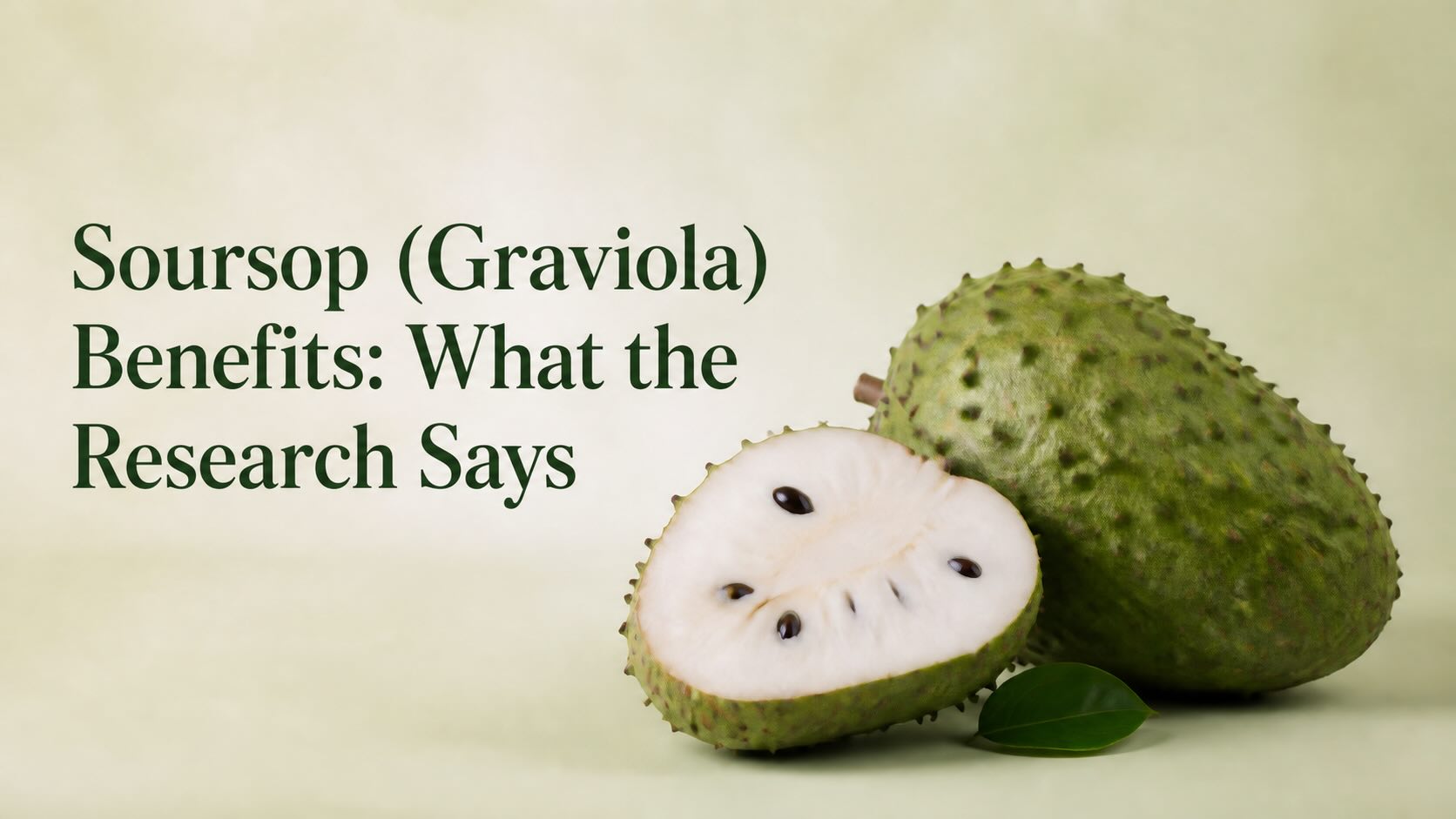
 Soursop—also called graviola, guanabana, or Annona muricata—is a tropical fruit known for its creamy white pulp and sweet-tart flavor. It also has a long history of use in traditional wellness practices.
More recently, soursop extracts and supplements have attracted attention for possible antioxidant, metabolic, antimicrobial, and anticancer properties. Here is what scientists currently know—and what remains uncertain.
The short answer
- Soursop fruit provides vitamin C, dietary fiber, potassium, and plant compounds.
- Its clearest evidence-based benefits come from its nutritional value as a whole fruit.
- Research involving inflammation, blood sugar, microbes, and cancer cells is mostly limited to laboratory or animal studies.
- Concentrated leaf products and frequent, long-term use require more caution than occasionally eating the seedless fruit.
1. Soursop provides vitamin C and fiber
A 100-gram serving of raw soursop provides approximately 66 calories, 20.6 milligrams of vitamin C, 3.3 grams of dietary fiber, and 278 milligrams of potassium.1 Exact values vary with the fruit’s variety, ripeness, and growing conditions.
Vitamin C contributes to normal immune function, collagen production, wound healing, and the protection of cells from oxidative damage. Fiber supports digestive regularity and can help make meals and snacks more satisfying.
2. It contains antioxidant plant compounds
Researchers have identified phenolic compounds, flavonoids, alkaloids, and other phytochemicals in different parts of the soursop plant. Fruit and leaf extracts have demonstrated antioxidant activity in laboratory tests.2
Antioxidants can neutralize certain reactive molecules under experimental conditions. However, a high antioxidant reading in a test tube does not automatically mean that a food prevents disease in the human body. Digestion, absorption, dose, preparation, and metabolism all influence what a compound ultimately does.
Soursop can therefore be described as a fruit containing antioxidant compounds.
3. Its fiber may support digestive health
The fiber in soursop is one of its most practical benefits. Dietary fiber adds bulk to stool, supports normal bowel regularity, and serves as a food source for parts of the gut microbiome.
Whole or puréed seedless pulp retains fiber, while heavily strained juice may contain much less. Sweetened soursop drinks can also contain added sugar, so checking the ingredient list is worthwhile.
Studies reporting antiulcer or antiparasitic effects have generally used concentrated extracts in laboratory or animal models.
4. Blood-sugar research is promising but preliminary
Soursop leaf extracts have lowered blood glucose or influenced glucose-related pathways in laboratory and animal studies. A systematic review concluded that Annona muricata deserves further investigation but emphasized the need for standardized preparations, established doses, and better-quality studies.3
These findings do not prove that soursop treats diabetes in people. It is also important to distinguish between eating the fruit—which naturally contains sugar—and taking a concentrated leaf extract.
People using insulin or other glucose-lowering medicines should consult a healthcare professional before taking concentrated soursop products. Combining substances that may lower glucose could potentially contribute to hypoglycemia.
5. Blood-pressure effects have mainly been studied in animals
Animal research suggests that soursop leaf extracts may have blood-pressure-lowering effects.4 Reliable clinical trials have not established an effective or safe human dose.
Anyone taking blood-pressure medication should speak with a clinician or pharmacist before using concentrated soursop preparations. Soursop should not be used as a substitute for prescribed medication.
6. Anti-inflammatory and antimicrobial findings need human confirmation
Soursop extracts have demonstrated anti-inflammatory, antibacterial, antifungal, antiviral, and antiparasitic activity in preclinical experiments.5 These findings help researchers identify compounds that may deserve further study.
7. Can soursop prevent or cure cancer?
This is the most important soursop claim to examine carefully.
Extracts and isolated compounds from soursop have inhibited or damaged several kinds of cancer cells in laboratory studies. Some animal experiments have also reported effects on tumor growth and biological pathways involved in cancer.6
These results are scientifically interesting. A substance can kill cancer cells in a laboratory dish and still be ineffective, poorly absorbed, or unsafe when used by a person.
Cancer Research UK likewise reports that there is not enough reliable evidence to use it as a cancer treatment.7
Are fruit, tea, and soursop extracts equivalent?
No. Different preparations can have very different chemical compositions:
- Fruit pulp is primarily a food supplying carbohydrates, fiber, vitamin C, and other nutrients.
- Leaf tea extracts compounds from the leaves, with strength depending on the amount used and brewing time.
- Tinctures, capsules, powders, and bitters may contain more concentrated or combined botanical ingredients.
- Seeds and bark are not food ingredients and are considered toxic.
Evidence about one preparation should not automatically be applied to another. A study involving a standardized leaf extract, for example, cannot establish the benefits of a juice, tea, or multi-herb blend.
Soursop safety considerations
Remove every seed
Soursop seeds should not be eaten or crushed into food or drinks. University of Florida IFAS Extension identifies the seeds and bark of soursop and related fruits as toxic.8
Consider the neurological research
Soursop contains annonaceous acetogenins, including annonacin. Laboratory research has found that annonacin can interfere with mitochondrial energy production and damage cultured nerve cells.9
Observational research in Caribbean populations has also reported an association between consumption of Annonaceae products and greater severity of certain Parkinson-like neurological disorders.10
Observational research cannot prove that soursop alone caused these conditions, and experimental doses do not establish a known safe or harmful human serving. Still, these findings justify caution with frequent, long-term, or highly concentrated use.
People with Parkinson’s disease, another movement disorder, or unexplained neurological symptoms should avoid concentrated soursop products unless their healthcare professional approves them.
Check for medication interactions
Consult a healthcare professional before using concentrated soursop products if you:
- take medicine that lowers blood sugar;
- take medicine that lowers blood pressure;
- are receiving cancer treatment;
- are preparing for medical imaging or laboratory testing;
- have liver, kidney, or neurological disease; or
- take multiple prescription medicines.
Memorial Sloan Kettering specifically advises people using blood-glucose or blood-pressure medication to discuss graviola with their healthcare provider.11
Pregnancy and breastfeeding
Reliable safety information for concentrated soursop products during pregnancy and breastfeeding is lacking. Most botanical supplements have not been adequately studied during these life stages, so professional guidance is recommended before use.12
The bottom line
Soursop is a flavorful tropical fruit that supplies vitamin C, fiber, potassium, and a variety of plant compounds. Those nutritional qualities are its best-supported benefits.
Research involving soursop extracts is intriguing, particularly in the areas of antioxidant activity, inflammation, glucose metabolism, and cancer biology. However, most of the evidence comes from cells or animals. Human clinical evidence remains too limited to establish soursop as a treatment for cancer, diabetes, high blood pressure, infection, or another medical condition.
Enjoying ripe pulp occasionally, with every seed removed, is not the same as taking a concentrated preparation. If you choose a soursop-containing botanical product, follow its label and consult a qualified healthcare professional when medications or health conditions are involved.
Footnotes
- Nutritional composition: USDA-derived data list approximately 66 calories, 20.6 mg of vitamin C, 3.3 g of fiber, and 278 mg of potassium per 100 g of raw soursop. USDA FoodData Central. ↩
- Antioxidant compounds: Research has measured phenolic compounds and antioxidant activity in soursop and other tropical fruits. View the research on PubMed. ↩
- Blood-glucose research: A systematic review identified possible antidiabetic mechanisms while emphasizing the need for standardized doses and further research. View the systematic review. ↩
- Blood-pressure research: Reported hypotensive effects have mainly been evaluated using extracts in animal models. View the study. ↩
- Preclinical pharmacological findings: Reviews describe antioxidant, anti-inflammatory, antimicrobial, and metabolic activity, but much of this evidence is not from human trials. View the comprehensive review. ↩
- Anticancer research: Laboratory and animal findings are promising, but clinical effectiveness in humans has not been established. View the anticancer review. ↩
- Independent cancer guidance: Memorial Sloan Kettering Cancer Center and Cancer Research UK report that reliable evidence supporting soursop as a cancer treatment is lacking. ↩
- Seed safety: University of Florida IFAS Extension identifies the seeds and bark of soursop and related Annona fruits as toxic. View the university resource. ↩
- Annonacin research: A laboratory study found that annonacin impaired cellular energy production and damaged cultured dopaminergic neurons. View the study. ↩
- Parkinsonism research: An observational study associated Annonaceae consumption with greater disease severity among Caribbean patients with degenerative parkinsonism. Association does not establish causation. View the study. ↩
- Interactions: Memorial Sloan Kettering discusses precautions involving blood-sugar medicine, blood-pressure medicine, and certain imaging tests. Read the clinical resource. ↩
- Pregnancy: Safety and effectiveness data are lacking for most botanical supplements during pregnancy. NIH Office of Dietary Supplements. ↩
Scientific research
- Safety and Tolerability of Annona muricata Leaf Extract: A Systematic Review
- Annona muricata and Hyperglycemia: A Systematic Review
- A Review on Annona muricata and Its Anticancer Activity
- Annonacin Toxicity in Dopaminergic Neurons
- Neurotoxicity of Dietary Supplements from Annonaceae Species
- Annonaceae Consumption and Degenerative Parkinsonism